Boat lifts are essential equipment for any boat owner who wants to protect their watercraft, simplify maintenance, and extend the life of their vessel. Instead of leaving your boat in the water where it is exposed to algae, corrosion, and hull damage, a boat lift raises it above the surface when not in use. This simple action prevents premature wear and makes cleaning and storage much easier.
This guide covers the basic operation, common types, and key components of boat lifts while highlighting the solutions offered by Seaside Marine Construction.
The Basic Definition of a Boat Lift
A boat lift is a mechanical system designed to raise and lower a watercraft in and out of the water. Its primary purpose is to keep the boat dry and safe when not in use, preventing damage from algae, corrosion, hull fouling, and UV rays. By lifting the boat above the waterline, you also reduce the need for frequent cleaning, bottom painting, and costly repairs. For waterfront property owners in South Florida, where the sun is intense and marine growth is aggressive, a boat lift is not just a convenience. It is an essential tool for protecting your investment.
Modern boat lifts operate on a simple principle. A cradle or platform supports the boat. A power source, which can be electric, hydraulic, pneumatic (air), or manual, provides the force to lift that cradle upward. When you want to use the boat again, the process reverses: the cradle lowers gently into the water, and you drive the boat off. The entire cycle can be controlled by a remote, a keypad, or a switch, making launching and docking effortless.
The Main Reasons to Use a Boat Lift
Boat lifts provide benefits that directly affect the longevity and value of your watercraft. These advantages are especially important in Florida, where warm waters accelerate growth and corrosion.
- Protection from marine growth: When a boat sits in warm Florida water for days or weeks, barnacles, algae, and zebra mussels attach to the hull. A boat lift keeps the boat dry, eliminating this problem. In Palm Beach and Broward County, where boating is a year round activity, this protection alone can save thousands in hull cleaning and antifouling paint.
- Corrosion prevention: Saltwater and even brackish water can cause metal parts, engine components, and electrical systems to corrode rapidly. Keeping the boat out of the water slows this process significantly. This is critical for boats stored in saltwater canals throughout South Florida.
- Hull safety: Floating debris, shifting water levels, and boat wakes can scar or damage the hull. A lift raises the boat above these hazards. In areas like Lake Worth or the New River, where boat traffic is heavy, this protection is invaluable.
- Reduced maintenance costs: You will spend less on bottom paint, cleaning, and anti fouling treatments. Many of our clients in Boca Raton and Fort Lauderdale report that a boat lift pays for itself within a few years through reduced maintenance alone.
- Improved shoreline aesthetics: A boat on a lift looks clean and organized. It eliminates the need for mooring lines and fenders cluttering your dock. This enhances the overall look of your waterfront property, which is especially important for homes with high property values along the water in Palm Beach County.
How a Boat Lift Works Step by Step
While there are several designs of boat lifts, the basic operation follows a similar sequence. Understanding this process helps you choose the right lift and use it correctly.
Positioning the Boat
You drive or guide the boat into the cradle. The cradle is a frame with supports that match the shape of the hull. Many lifts have guide posts or docking guides that help center the boat, so you do not need to be perfectly aligned. In the narrow canals of Broward County, these guides are especially helpful for tight maneuvering.
Activating the Lift
Once the boat is in position, you activate the lift using a control box, remote, or manual crank. The power source begins to work. Electric motors turn a winch that pulls cables. Hydraulic pumps push fluid into cylinders. Air compressors fill bladders with compressed gas. For many of our Boat Lift installations in Palm Beach County, we recommend electric lifts for their reliability and ease of use, especially for owners who want push button operation.
Raising the Cradle
As the force is applied, cables or chains attached to the cradle pull it upward. Alternatively, pneumatic bladders expand and lift the entire platform. The boat rises out of the water until the hull is completely clear. A locking mechanism or brake holds the lift in place. The time required depends on the boat size; a small center console may lift in 20 seconds, while a larger yacht may take a minute or more.
Lowering and Launching
To use the boat again, you release the lock or reverse the power. The cradle lowers slowly. Once the boat floats, you drive it off the lift. In South Florida, where sudden thunderstorms are common, being able to launch quickly is a real advantage.
The Four Major Types of Boat Lifts
There is no single best boat lift for every situation. The right choice depends on your dock type, water depth, boat size, and local conditions. In South Florida, we see a wide variety of installations because of the diverse waterfront environments from oceanfront homes in Palm Beach to canal properties in Fort Lauderdale.
Free Standing Lifts
A free standing boat lift sits directly on the bottom of the lake or ocean. It is a self contained unit that does not attach to the dock or pilings. These lifts can be manual, electric, hydraulic, or solar powered. Free standing lifts are popular for open water where the bottom is firm and stable. In South Florida, they are commonly used in areas like the C 51 Canal or the Hillsboro Canal, where the bottom is sandy and consistent.
However, free standing lifts require sufficient water depth and a bottom that can support the weight of the lift and boat. In some parts of Broward County, where the bottom may be soft or mucky, pilings are a better choice.
Piling Mount Lifts
Piling mount lifts are attached to four permanent pilings driven into the seabed. They do not require a boathouse. The lift structure rests on top of the pilings. This design is stable and works well with fixed docks, which are common along the Intracoastal Waterway in both Palm Beach and Broward County.
Piling mounts handle heavy boats well and offer a clean look because the marine pilings are often hidden underwater. They are ideal for locations where the water is deep enough to drive pilings and the bottom is strong.
Floating Boat Lifts
Floating boat lifts, also called drive on lifts, float on the water surface. They rise and fall with the water level, making them the only type suitable for floating docks. Most floating lifts use pneumatic power. Compressed air fills bladders inside the lift structure, causing it to rise and lift the boat.
An important consideration: If you try to place a fixed or piling mounted lift on a floating dock, any change in water depth or current will render the lift inoperable because the lift cannot float and self right with rising or lowering water. This is a common mistake we see in South Florida, where many docks are floating due to fluctuating water levels.
Floating lifts are very common in areas like the Lake of the Ozarks, but in South Florida they are also used on floating docks in places like the New River in Fort Lauderdale and the canals of Delray Beach.
Overhead and Boathouse Lifts
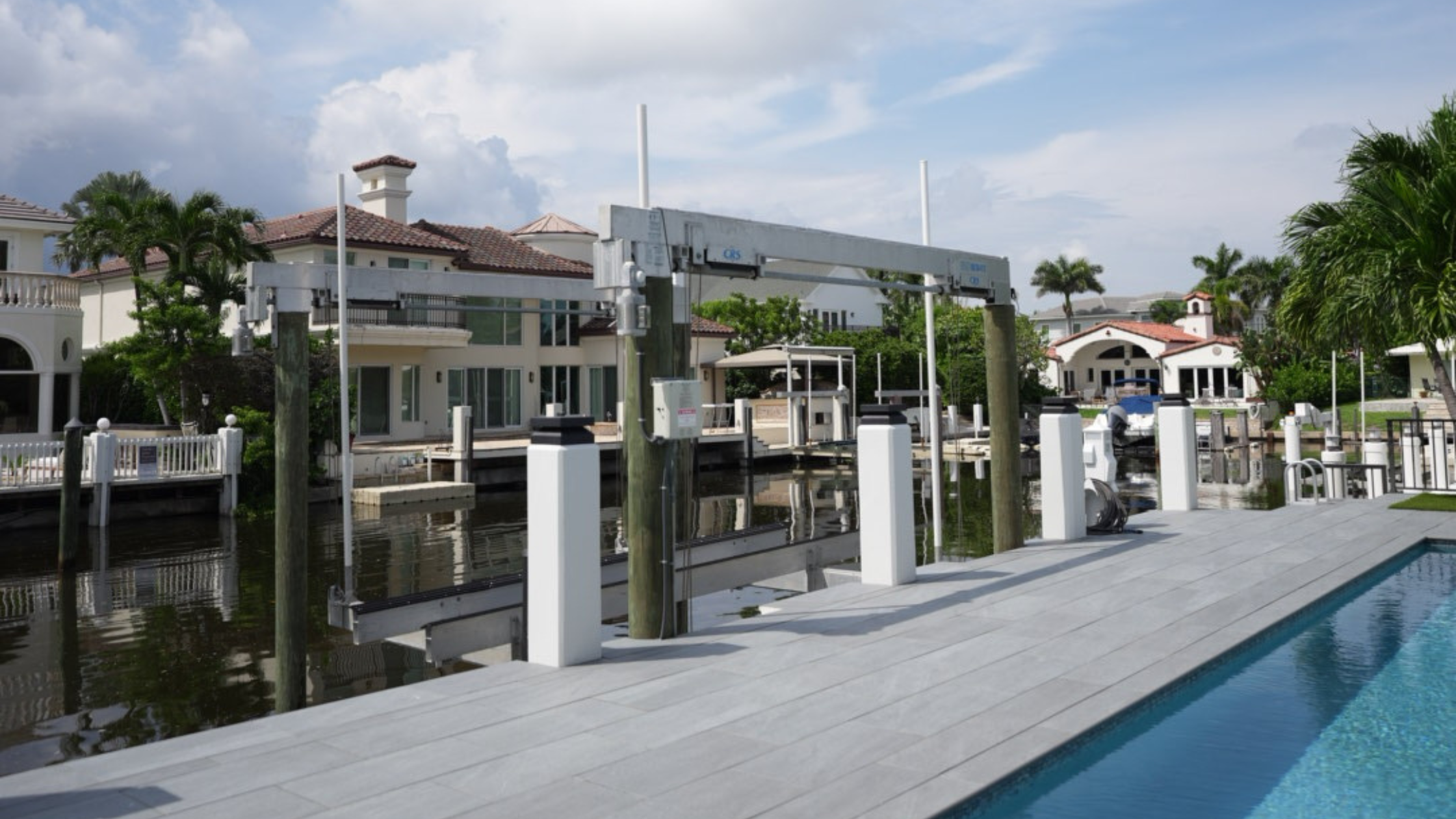
Overhead boat lifts, also called boathouse lifts or bridge lifts, use an overhead support structure to raise and lower the boat. They are often integrated into a permanent boathouse or dock roof. A trolley system or bridge style track moves the boat vertically.
These lifts keep the boat completely out of the water and protected from weather. They are ideal for regions where waterways do not freeze, providing year round operation. In South Florida, where freezing is not a concern, overhead lifts are a popular choice for luxury homes along the Intracoastal Waterway. They offer a streamlined appearance and can handle very large boats.
Elevator Boat Lifts
Elevator boat lifts run on rails mounted to the dock or seawall. They are designed for narrow canals or areas where a traditional cradle lift cannot fit. The boat sits on a platform that moves up and down on vertical rails. These lifts are common in South Florida, especially in Palm Beach and Broward County, where canals are tight and water depths vary.
Seaside Marine Construction specializes in elevator boat lifts because they solve space problems that other lifts cannot. For example, a property on a narrow canal in Boca Raton may not have room for a piling mount or floating lift. An elevator lift uses vertical space instead of horizontal space, making it the perfect solution.
Key Components of a Boat Lift
A boat lift consists of several essential parts that work together. Knowing these components helps you understand how the lift operates and how to maintain it.
- Cradle or Platform: The structure that supports the hull. It is often made of aluminum for corrosion resistance, which is essential in the saltwater environment of South Florida. The cradle includes bunks or pads that conform to the shape of the boat.
- Cables or Chains: These connect the cradle to the lifting mechanism. High grade stainless steel cables are common for saltwater applications. In Palm Beach and Broward County, where saltwater exposure is constant, using the right cable material is critical.
- Power Unit: This can be an electric motor, a hydraulic pump, or an air compressor. The power unit provides the force to lift the cradle. For most of our installations in South Florida, we recommend electric units because they are quiet, clean, and easy to operate.
- Controls: A switch, keypad, or remote control that sends signals to the power unit. Some lifts include wireless controls for convenience. We offer options that allow you to operate your lift from inside your home or from your boat.
- Frame: The main structural frame that holds everything together. It can be aluminum or steel. Aluminum is preferred in saltwater because it does not rust. For coastal properties in Broward County, we almost always specify aluminum frames.
- Guide Posts: Vertical posts on the sides of the cradle that help center the boat as you drive onto the lift. These are especially helpful in windy conditions, common along the coast of Palm Beach.
Choosing the Right Boat Lift for Your Dock
Selecting the right boat lift requires evaluating your specific situation. The following factors are the most important, especially for South Florida property owners.
Location and Structural Strength
Where you plan to install the lift determines the structural strength required. Calm sheltered areas in the interior canals of Boca Raton may need less reinforcement than exposed rough water locations along the Atlantic inlets.
Boat Size and Weight
The size of your boat is a huge determining factor. You need a lift that can accommodate the length, beam, and weight of your vessel. Consider the dry weight plus fuel, gear, and propellers. Ensure the cradle is long enough so neither end of the boat hangs over too far. In Palm Beach County, where large yachts are common, we often install heavy duty 8 post lifts for boats over 30 feet.
Water Depth and Bottom Conditions
In shallow water, a free standing lift may not work because the bottom must be deep enough for the cradle to fully submerge. Floating lifts are better for shallow or variable depth areas. If the bottom is muddy or soft, piling mounts or floating lifts are more reliable. Many canals in Broward County have soft bottoms, so we often recommend piling mounts or elevator lifts.
Dock Type
- Fixed docks can use free standing, piling mount, or overhead lifts.
- Floating docks require floating lifts or elevator lifts.
Using the wrong type on a floating dock can damage the lift and the boat. We have seen this happen in several South Florida communities where homeowners tried to install a fixed lift on a floating dock.
Local Regulations and Permits
Most areas require permits to install a boat lift on navigable waters. In Palm Beach and Broward County, permits must be obtained from local water management districts and building departments. Seaside Marine Construction handles all design, permitting, and installation to ensure compliance. We have years of experience working with local authorities in South Florida, so the process is smooth for our clients.
Final Thoughts
A boat lift is a smart investment for any boater who wants to keep their vessel in excellent condition. By lifting the boat out of the water, you eliminate exposure to harmful elements and make your time on the water more enjoyable. Whether you choose a free standing lift for open water, a floating lift for a floating dock, or an elevator lift for a tight canal, the right system will serve you for decades.
If you are considering adding a boat lift to your dock, contact us for a free consultation. We will help you choose the perfect lift for your boat and your lifestyle.